Tag Archives: TMC-The Mahr Company

Top 10 Reasons to Move to Tampa Bay

Image

Top 10 Reasons to Move to Tampa Bay

Sourced By: Image

1. WORKFORCE

Tampa Bay ranked among the top 10 large metro areas for college-educated young talent on the move. The latest Census data reveals that young people aged 25 to 29 are increasingly more mobile and willing to move to new cities, very often in new states, in search of jobs.

2. K-12 EDUCATION

Florida leads the nation in high school seniors taking Advanced Placement exams at nearly 50 percent. Florida also ranks sixth in the nation for the percentage of students who score a 3 or higher on the AP exam at 23.9 percent, compared to the national average of 18.1 percent.

3. PROGRESSIVE TRAINING

An independent analysis of the CareerEdge Funders Collaborative by Urban Market Ventures found that the investments made by the nonprofit workforce-development program is producing millions of dollars in new wages and economic impact for the Tampa Bay region.

4. MILITARY INVESTMENT

Tampa Bay is home to MacDill Air Force Base, the only military installation that hosts two, four-star Combatant Commands, the U.S. Central Command and U.S. Special Operations Command. MacDill contributes $5 billion annually to the greater Tampa Bay economy.

5. AMAZING PARKS AND RECREATION

Tampa’s Curtis Hixon Park was named among America’s Best New Parks by The Atlantic Cities. Completed in 2011, the waterfront park serves as a more natural connection between the water, downtown, and the new Children’s Museum and Tampa Art Museum. Tampa Bay’s beloved public spaces spread throughout the region provide gathering places for families, friends, colleagues, and events from small to large scale.

6. PROMISING AND ADMIRED COMPANIES

Some of America’s most promising companies are located in Tampa Bay. Sarasota-based Internet communication systems and service provider, Star2Star Communications was named among America’s 100 Most Promising Companies by Forbes. The company also made the 2011 Inc. 500 list of fastest growing private companies.

7. INNOVATIVE UNIVERSITIES

The University of South Florida is ranked 50th in the nation for research expenditures by the National Science Foundation among all U.S. universities, public or private, joining the ranks of Johns Hopkins, Stanford, Yale and Harvard.

8. EXPANSIVE MEDIA REACH

The Tampa Bay region is the 14th largest television media market in the country, with 1.79 million TV households, according to Nielsen Media Research. That means Tampa Bay has 1.6 percent of all television households in the United States. It is the largest market in Florida – surpassing Miami. If you’re looking for media exposure, you’ve found it.

9. LOW COST OF DOING BUSINESS

According to a KPMG business cost study, the Tampa Bay market is the nation’s lowest cost large market for Corporate Services, International Financial Services and Shared Services – a testament to strong business, financial and data services sector in Tampa Bay.  KPMG’s 2012 Competitive Alternatives study measured 26 significant cost components over a 10 year planning horizon.  Bottom line – Tampa Bay is a great place for business.

10. HOT ENTREPRENEURIAL ENVIRONMENT

According to FastCompany Magazine, Florida’s start-up environment is soaring high. From the HuB in Sarasota to Tampa Bay WaVE’s First WaVE program to large events such as Start-Up Weekend and initiatives like the Tampa Bay 6/20 Plan, Tampa Bay’s entrepreneurial environment is setting up for start-up success.

We Are Dedicated To Serving YOU

We are dedicated to serving you. To being the best we can be in your service and in the accomplishment of your goals. As such we embrace this approach to being a more efficient, productive and entrepreneurial business to best serve you.

The below was created by: Anna Vital infographic author http://anna.vc/

Image

TMC-The Mahr Company EXCELLENCE IN THE DETAILS:
Selectively working with clients and prospective clients, while building lifelong working relationships.
Our Services solve your problems, saving you time and money.
The TMC team offers focused and skilled professional services, tailored to achieve your goals

Difference Between Cap Rate and Discount Rate

Image

Difference Between Cap Rate and Discount Rate

By propertymetrics

What is the difference between a cap rate and a discount rate? Because these concepts are often confused, this article will discuss the difference between a capitalization rate and a discount rate in commercial real estate, and leave you with a clear understanding of the two concepts.

First, let’s go over a couple of definitions, and then we’ll dive into a specific example.

Cap Rate

The capitalization rate, often just called the cap rate, is the ratio of Net Operating Income (NOI) to property asset value. So, for example, if a property was listed for $1,000,000 and generated an NOI of $100,000, then the cap rate would be $100,000/$1,000,000, or 10%.


cap rate


What is a cap rate in commercial real estate useful for? Because individual properties differ greatly in size and magnitude, it’s helpful to talk about property prices and values in a common language. Thinking of property value per dollar of current net income achieves this objective.

The cap rate is simply a measure that quantifies property value per dollar of current net income. Another way to think about the cap rate is that it’s the inverse of the popular price/earnings multiple used in the stock markets.

Discount Rate

The discount rate is the rate used in a discounted cash flow analysis to compute present values.

When solving for the future value of money set aside today, we compound our investment at a particular rate of interest. When solving for the present value, the problem is one of discounting, rather than growing, and the required expected return acts as the discount rate. In other words, discounting is merely the inverse of growing.

What is the discount rate used for in commercial real estate analysis? In commercial real estate the discount rate is used in a discounted cash flow analysis to compute a net present value. Typically, the investor’s required rate of return is used as a discount rate, or in the case of an institutional investor, the weighted average cost of capital. This ensures that the initial investment made in a property achieves the investor’s return objectives, given the projected cash flows of the property. The intuition behind IRR and NPV is that it allows us to determine how much an investor should pay for a property, given his required rate of return, or discount rate.

Cap Rate vs Discount Rate

So, back to the original question – what’s the difference between the cap rate versus the discount rate? The cap rate allows us to value a property based on a single year’s NOI. So, if a property had an NOI of $80,000 and we thought it should trade at an 8% cap rate, then we could estimate its value at $1,000,000.

The discount rate, on the other hand, is the investor’s required rate of return. The discount rate is used to discount future cash flows back to the present to determine value and account’s for all years in the holding period, not just a single year like the cap rate.

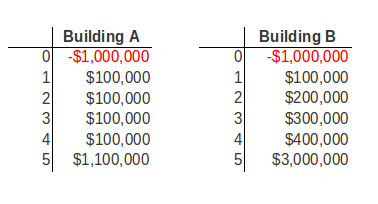
If a property’s cash flows are expected to increase or decrease over the holding period, then the cap rate will be a misleading performance indicator. Consider the following two investment alternatives:

cap rate vs discount rate

Both properties have a cap rate of 10% based on the NOI in year 1. But clearly the cash flows are better for Building B and it therefore provides a higher rate of return. The exact rate of return can be quantified using the Internal Rate of Return (IRR). Also, assuming equal risk, any rational investor should be willing to pay more for Building B because its future cash flows are expected to grow more than Building A’s. But how much more could you pay for Building B while still achieving your required return?

By completing a multiyear discounted cash flow analysis we could quantify exactly how much we can pay for this property with a Net Present Value (NPV), given an investor’s discount rate. The cap rate, on the other hand, will not be able to answer this question for us. In short, while the cap rate and the discount rate may appear similar, they are two different things used for different purposes.

Key To Commercial Real Estate Investing is Timing

The Key To Investing in Commercial Real Estate Is Timing. Ask us how we can assist you in identifying the right strategies for your commercial real estate investments, whether acquisitions or dispositions.

The Impact of Millennials on Commercial Real Estate– A Look at Commercial Real Estate in 2014

Emerging Trends – A Look at Commercial Real Estate in 2014

Paraphrased from article by By Michael Bull, CCIM |

2014 should be another year of improvement across all commercial real estate sectors, according to the “Emerging Trends in Real Estate 2014” report conducted by PricewaterhouseCoopers (PwC) and the Urban Land Institute (ULI).

Produced for the last 35 years, Emerging Trends is one of the most anticipated and respected forecasts for U.S. real estate. Interesting not only for its analysis of past and current performance trends to forecast future results, the report also looks forward by interviewing 1,000 U.S. real estate executives, investors, developers and market experts about their plans and market predictions.

Answering the Interest Rate Question

“While we were doing our interviews from July through early October, interest rates were on everybody’s mind,” said Mitch Roschelle, partner and U.S. real estate advisory practice leader for PwC. “In 2010, 17.7 percent thought the real estate market would be good to excellent. In this year’s survey, 67.8 percent thought 2014 will be good to excellent, so that tells you that rates won’t chill the market.”

If net operating income growth remains on pace with an increase in the cost of capital, the market can digest a rise in interest rates, Roschelle said. Additionally, lenders indicated that underwriting standards are loosening and spreads are compressing because of the profitability of banks, he added.

Lending Environment

As the economy continues to improve, lenders are getting back in the real estate game, guests said. A significant amount of capital still flows into the multifamily sector, but there is also capital available for retail projects in secondary markets, said Andy Warren, director of real estate research for PwC.

“Lenders are beginning to expand what they are willing to look at in terms of deals,” he added. Regional banks have started to open up and contribute more to the lending environment, Warren said.

“CMBS will be a big story in 2014,” Roschelle affirmed. “In fact, it’s leading the list of lenders for 2014. The CMBS market lagged in the past, so that’s big.”

Looking ahead to 2015, shadow banking will be a big trend, Roschelle said. “Funds are aggregating capital and putting it out in the form of somewhat conventional financing for commercial real estate,” he said. “It’s going to be bigger and bigger in the months to come.”

Investors Bullish on Texas and Florida

While technology-driven markets such as San Francisco and San Jose, Calif., remain high on investors’ lists, Texas has emerged as an important investment target, Warren said. “Dallas, Houston, Austin and Fort Worth are all in the top 10 markets for investors,” he said. “If you add in San Antonio, which is in the top 20, you have all four major metro areas in Texas as top markets for this year.”

One notable change in the survey was the decline of investor interest in the nation’s capital. “Washington, D.C., continued to perform strongly during the downturn because the federal government held up. Now with the discussions about the fiscal cliff and budget ceiling, it’s beginning to have a blow-back effect on the local market,” Warren added.

The Impact of Millennials on Commercial Real Estate

“People between the ages of 15 and 29 years old represent 28.5 percent of the population, the single largest group,” Roschelle said. “Decisions about commercial real estate are going to be made around Millennials for years to come.”

“Apartments are the first thing that come to mind,” Warren said. Millennials are looking for apartments in an urban setting that foster a “live, work, play” environment. “This is having a huge impact on major cities.”

However, the impact of Millennials expands beyond the multifamily market. Office environments are being reconfigured into a more open floor plan in order to attract and retain Millennials, Warren added.

Retailers are following Millennials from suburban to urban markets, developing new store layouts that will work in urban areas. The industrial market has been impacted as well because online sales are up, which means fulfillment centers will continue to be created to meet this uptick in demand. “Millennials have touched much more than just apartments,” Warren said.


Market Analysis: “A Stronger Asset” from CCIM Institute

New sources of capital and increased demand have strengthened the commercial real estate market.
by William Hughes

The current economic landscape has assembled an array of factors to structurally change real estate investment standards. The intertwining of the U.S. and global economies, deeper integration of liability and equity markets, and the accelerated adoption of real estate investment trusts and commercial mortgage-backed securities as major components of the sector have all contributed to this evolution. Furthermore, increased access to a variety of capital sources, combined with a multitude of real estate investment vehicles, has resulted in real estate investment earning its place as a mainstream asset class.

For today’s real estate investor, advanced facts and figures, deeper liquidity, and a range of broad investment opportunities that reach beyond merely primary metros have all allowed the further mitigation of risk. As supply cycles continue their two-decade trend of stabilization, the sector remains less volatile as a whole. Convergence of these influences has refined the foundation for attractive real estate cost positioning, resulting generally in falling capitalization rates over the last 20 years.

Cap Rate Movement

Typically, cap rates are inclined to stay range-bound during economic inflection points, with a usual variance of between 100 and 130 basis points. Whereas the length and severity of the the 2009 Great Recession and the 2001 Recession were markedly different, the recovery trends of cap rate performance proved surprisingly similar.

During the peak of the financial crisis, cap rates expanded from 6.9 percent to 8.1 percent between 2007 and 2009 before making a remarkably accelerated recovery, especially given the depth of the recession, according to figures from Real Capital Analytics, CoStar, and Marcus & Millichap Research Services. While the annualized yield on the 10-year Treasury declined 280 basis points to 1.8 percent between 2002 and 2012, the mean annualized cap rate for all property types dropped 150 basis points. Since the end of 2012, the 10-year yield has abruptly expanded 100 basis points to 2.9 percent as of September 2013. In evaluation, the mean cap rate proved more steady, edging down only about 10 basis points to 7.2 percent. While a delayed effect is still a possibility, forecasting the potential magnitude requires deeper analysis.

Throughout the Great Recession, the Federal Reserve has held the federal funds rate to nearly zero while infusing huge volumes of capital into the financial markets. The expanded period of monetary easing and the absence of government-supported distress sales have boosted the national mortgage market. This paved the way for cap rates and real estate values to bounce back far more quickly than in previous recessions and well ahead of an actual operating recovery. The exception to this trend occurred in multifamily properties, which recovered even faster than the other sectors.

Whereas tough credit underwriting continues to be an obstacle for potential borrowers, the Federal Reserve’s accommodative policies aimed at reducing near-term interest rate risk have aided in the refinancing and restructuring of maturing and difficult loans. This has resulted in more capital entering real estate as a comparatively sound alternative to reduced yield bonds and volatile equity markets.

A Hybrid Investment

Since the market bottomed in 2009-10, commercial real estate investors have favored the greater certainty of top-tier markets and properties with proven cash flows, despite their generally lower yields; this focus on prime markets limited meaningful price recovery to coastal and urban core markets, until investor interest began to spread a year-and-a-half ago. With most gateway primary markets having substantially recovered, occupancy and rent growth momentum has expanded to late-recovery secondary and tertiary metros. These areas may garner higher yields and offer room for net operating income gains, but they also carry higher risk. Many of these areas face relatively higher overdevelopment threats, less consistent demand, and more shallow liquidity, all of which could affect investor exit strategies. Reflecting these trends, the maturing primary markets have faced slowing cap rate compression and even rate upticks. Conversely, cap rates in secondary markets have tightened, supported by stronger operational momentum and sales volume. Naturally, investor risk will depend in part upon a market’s position along the arc of the real estate cycle and the investment time horizon.

The hybrid nature of commercial real estate makes it a compelling investment option, with a bond-like cash flow component even during economic downturns, as well as an appreciation component that often acts as a hedge against inflation, considering that property owners benefit from increasing rents and property values when inflation rises. In addition, many long-term leases contain consumer price index rent increases, while shorter-term leases allow investors to quickly adjust to market rates.

Rising Interest Rates

A period of falling cap rates helps elevate returns via appreciation. Rising interest rates — reflecting stronger economic activity — generally exert upward pressure on cap rates, requiring an increased emphasis on income growth to offset slower appreciation and higher financing cost. However, healed and expanding credit markets, strong global investor demand for U.S. real estate, and continued recovery in property fundamentals will help counterbalance the magnitude of rising rates, and lend support to property values. Having already absorbed a significant increase in interest rates, further cap rate changes should tie less to speculation regarding Fed policy and correlate more with measurable economic performance.

Debt and equity markets should remain stable for the foreseeable future. However, the environment is not without risk, and near-term volatility should be expected. The pending appointment of a new Federal Reserve chief, looming debt ceiling discussions, geopolitical tensions in the Middle East, and the effects of sequestration and declines in federal spending will hamper economic growth.

In addition, changes in monetary policy always present a risk to the economy. In this light, the Fed has demonstrated considerable dexterity, and should gradually exit qualitative easing in an orderly manner by slowly decreasing bond purchases and letting some securities mature. The Federal Open Market Committee has issued interest rate guidance, stating that the federal funds will remain range-bound between 0 to .25 percent at least until mid-2015, underscoring that monetary tightening would begin only after an economic and employment recovery has been well established. The Fed also noted that the tightening process would occur at a more gradual pace than historical precedent. 

Surely, higher interest rates will impact investors across the board. As financing costs rise, so will investors’ required returns. At a minimum, increased financing costs will decay some of the cap rate arbitrage of buying into secondary and tertiary markets, or value-add and opportunistic assets. However, the stride of occupancy and lease growth is likely to exceed that of primary markets and core assets for the midterm outlook. Demand for all commercial real estate, sustained by the reinforcing economy, remains solid, and supply risks are negligible for most property types. As a result, performance profits and other components will considerably counteract the effect of rising interesting rates, at least for the near term.  William Hughes

Tampa Mayor Bob Buckhorn and Sanford Mahr

TMC-The Mahr Company’s Sanford Mahr with Tampa Mayor Bob Buckhorn at Mayor’s breakfast at The University Club this morning. Fabulous overview of many exciting developments for Tampa by Mayor Buckhorn. Please ask us how we can be of service to help position you and your company for what is being planned.