Tag Archives: Commercial Real Estate Brokerage Tampa Bay

We Are Dedicated To Serving YOU

We are dedicated to serving you. To being the best we can be in your service and in the accomplishment of your goals. As such we embrace this approach to being a more efficient, productive and entrepreneurial business to best serve you.

The below was created by: Anna Vital infographic author http://anna.vc/

Image

TMC-The Mahr Company EXCELLENCE IN THE DETAILS:
Selectively working with clients and prospective clients, while building lifelong working relationships.
Our Services solve your problems, saving you time and money.
The TMC team offers focused and skilled professional services, tailored to achieve your goals

Lessons Learned From Outside The Industry

ImageTMC The Mahr Company lessons from outside the industry: [The Seattle Seahawks, Bono and U2, and Bank of America]: (1) Reinvent with CANEI (Constant and Never Ending Improvement), (2) Stay with or ahead of trends, (3) Brand, Promote, Execute, Deliver,(4) Contribute to the greater good, (4) Dare to excel and surround yourself with talented motivated people desiring the same, (5) Do not accept other’s preconceived expectations,(6) Failure is not an option, Take action and act as if it is impossible to fail, (7) Proceed as if limits to your ability do not exist: The Seattle Seahawks Nail it. Nike transforms their uniforms to perhaps the coolest in the NFL, Bono and U2 deliver for the Bank of America in support of RED with “Invisible”, Coach Carroll assembles a team with talent to spare. they execute and deliver…..   Follow this link for U2’s “Invisible” http://bit.ly/1iljxDF

Difference Between Cap Rate and Discount Rate

Image

Difference Between Cap Rate and Discount Rate

By propertymetrics

What is the difference between a cap rate and a discount rate? Because these concepts are often confused, this article will discuss the difference between a capitalization rate and a discount rate in commercial real estate, and leave you with a clear understanding of the two concepts.

First, let’s go over a couple of definitions, and then we’ll dive into a specific example.

Cap Rate

The capitalization rate, often just called the cap rate, is the ratio of Net Operating Income (NOI) to property asset value. So, for example, if a property was listed for $1,000,000 and generated an NOI of $100,000, then the cap rate would be $100,000/$1,000,000, or 10%.


cap rate


What is a cap rate in commercial real estate useful for? Because individual properties differ greatly in size and magnitude, it’s helpful to talk about property prices and values in a common language. Thinking of property value per dollar of current net income achieves this objective.

The cap rate is simply a measure that quantifies property value per dollar of current net income. Another way to think about the cap rate is that it’s the inverse of the popular price/earnings multiple used in the stock markets.

Discount Rate

The discount rate is the rate used in a discounted cash flow analysis to compute present values.

When solving for the future value of money set aside today, we compound our investment at a particular rate of interest. When solving for the present value, the problem is one of discounting, rather than growing, and the required expected return acts as the discount rate. In other words, discounting is merely the inverse of growing.

What is the discount rate used for in commercial real estate analysis? In commercial real estate the discount rate is used in a discounted cash flow analysis to compute a net present value. Typically, the investor’s required rate of return is used as a discount rate, or in the case of an institutional investor, the weighted average cost of capital. This ensures that the initial investment made in a property achieves the investor’s return objectives, given the projected cash flows of the property. The intuition behind IRR and NPV is that it allows us to determine how much an investor should pay for a property, given his required rate of return, or discount rate.

Cap Rate vs Discount Rate

So, back to the original question – what’s the difference between the cap rate versus the discount rate? The cap rate allows us to value a property based on a single year’s NOI. So, if a property had an NOI of $80,000 and we thought it should trade at an 8% cap rate, then we could estimate its value at $1,000,000.

The discount rate, on the other hand, is the investor’s required rate of return. The discount rate is used to discount future cash flows back to the present to determine value and account’s for all years in the holding period, not just a single year like the cap rate.

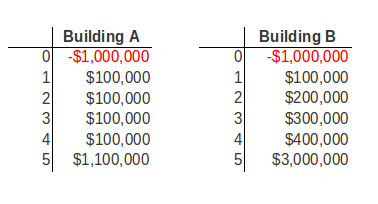
If a property’s cash flows are expected to increase or decrease over the holding period, then the cap rate will be a misleading performance indicator. Consider the following two investment alternatives:

cap rate vs discount rate

Both properties have a cap rate of 10% based on the NOI in year 1. But clearly the cash flows are better for Building B and it therefore provides a higher rate of return. The exact rate of return can be quantified using the Internal Rate of Return (IRR). Also, assuming equal risk, any rational investor should be willing to pay more for Building B because its future cash flows are expected to grow more than Building A’s. But how much more could you pay for Building B while still achieving your required return?

By completing a multiyear discounted cash flow analysis we could quantify exactly how much we can pay for this property with a Net Present Value (NPV), given an investor’s discount rate. The cap rate, on the other hand, will not be able to answer this question for us. In short, while the cap rate and the discount rate may appear similar, they are two different things used for different purposes.

The Impact of Millennials on Commercial Real Estate– A Look at Commercial Real Estate in 2014

Emerging Trends – A Look at Commercial Real Estate in 2014

Paraphrased from article by By Michael Bull, CCIM |

2014 should be another year of improvement across all commercial real estate sectors, according to the “Emerging Trends in Real Estate 2014” report conducted by PricewaterhouseCoopers (PwC) and the Urban Land Institute (ULI).

Produced for the last 35 years, Emerging Trends is one of the most anticipated and respected forecasts for U.S. real estate. Interesting not only for its analysis of past and current performance trends to forecast future results, the report also looks forward by interviewing 1,000 U.S. real estate executives, investors, developers and market experts about their plans and market predictions.

Answering the Interest Rate Question

“While we were doing our interviews from July through early October, interest rates were on everybody’s mind,” said Mitch Roschelle, partner and U.S. real estate advisory practice leader for PwC. “In 2010, 17.7 percent thought the real estate market would be good to excellent. In this year’s survey, 67.8 percent thought 2014 will be good to excellent, so that tells you that rates won’t chill the market.”

If net operating income growth remains on pace with an increase in the cost of capital, the market can digest a rise in interest rates, Roschelle said. Additionally, lenders indicated that underwriting standards are loosening and spreads are compressing because of the profitability of banks, he added.

Lending Environment

As the economy continues to improve, lenders are getting back in the real estate game, guests said. A significant amount of capital still flows into the multifamily sector, but there is also capital available for retail projects in secondary markets, said Andy Warren, director of real estate research for PwC.

“Lenders are beginning to expand what they are willing to look at in terms of deals,” he added. Regional banks have started to open up and contribute more to the lending environment, Warren said.

“CMBS will be a big story in 2014,” Roschelle affirmed. “In fact, it’s leading the list of lenders for 2014. The CMBS market lagged in the past, so that’s big.”

Looking ahead to 2015, shadow banking will be a big trend, Roschelle said. “Funds are aggregating capital and putting it out in the form of somewhat conventional financing for commercial real estate,” he said. “It’s going to be bigger and bigger in the months to come.”

Investors Bullish on Texas and Florida

While technology-driven markets such as San Francisco and San Jose, Calif., remain high on investors’ lists, Texas has emerged as an important investment target, Warren said. “Dallas, Houston, Austin and Fort Worth are all in the top 10 markets for investors,” he said. “If you add in San Antonio, which is in the top 20, you have all four major metro areas in Texas as top markets for this year.”

One notable change in the survey was the decline of investor interest in the nation’s capital. “Washington, D.C., continued to perform strongly during the downturn because the federal government held up. Now with the discussions about the fiscal cliff and budget ceiling, it’s beginning to have a blow-back effect on the local market,” Warren added.

The Impact of Millennials on Commercial Real Estate

“People between the ages of 15 and 29 years old represent 28.5 percent of the population, the single largest group,” Roschelle said. “Decisions about commercial real estate are going to be made around Millennials for years to come.”

“Apartments are the first thing that come to mind,” Warren said. Millennials are looking for apartments in an urban setting that foster a “live, work, play” environment. “This is having a huge impact on major cities.”

However, the impact of Millennials expands beyond the multifamily market. Office environments are being reconfigured into a more open floor plan in order to attract and retain Millennials, Warren added.

Retailers are following Millennials from suburban to urban markets, developing new store layouts that will work in urban areas. The industrial market has been impacted as well because online sales are up, which means fulfillment centers will continue to be created to meet this uptick in demand. “Millennials have touched much more than just apartments,” Warren said.


Commercial Real Estate Agents- Start Your Own Firm/Join A Large CRE Firm/Be Entrepreneurial And Part Of An Established Team ?

Commercial Real Estate Agents -Start Your Own Firm/Join Large CRE Firm/Be Entrepreneurial – Excerpts from Article by Michael Bull, CCIM as modified

January 8, 2014

Some commercial real estate brokers like the idea of owning their own company and some do hang their own shingle. They soon find the combination of the required time, costs and risks create less income and value than remaining a productive broker at an existing firm.  Why does this continually happen and is there an alternative for brokers to benefit from company synergy, equity in deals and an override commission structure without the detriments?

Economies of scale come into play, as well as capture of market share. It can be difficult to compete, as the expense of the tools and resources needed to be competitive can be difficult to budget . There are many other aspects that create issues for the broker turned business owner including the fact that productive sales people do not typically enjoy or make good managers.

The perfect situation for a broker would be the benefits of company synergy, equity in deals and an override commission structure, but without any of the detriments. It would be nice to have a prestigious title ownership,  plus an opportunity to participate in equity deals, team synergy and override commission structure each year.  Can a broker in a commission based industry achieve this without the requisite risks, costs and hassle of running a firm? Contact us confidentially to explore the possibilities and see if you qualify to be a part of the growth and opportunity of TMC-The Mahr Company going forward for 2014.